Show code
#collapse_show
%matplotlib inline
import numpy as np
import tensorflow as tf
import tensorflow_probability as tfp
from d2l import tensorflow as d2l

from matplotlib_venn import venn2“This notebook tries to solve the probability exercises in d2l.ai”
#collapse_show
%matplotlib inline
import numpy as np
import tensorflow as tf
import tensorflow_probability as tfp
from d2l import tensorflow as d2l
from matplotlib_venn import venn2#collapse_show
def plot_estimates(estimates, title_str):
d2l.set_figsize((6, 4.5))
for i in range(6):
d2l.plt.plot(estimates[:, i].numpy(), label=("P(die=" + str(i + 1) + ")"))
d2l.plt.axhline(y=0.167, color='black', linestyle='dashed')
d2l.plt.gca().set_xlabel('Groups of experiments')
d2l.plt.gca().set_ylabel('Estimated probability')
d2l.plt.legend();
d2l.plt.title(title_str)## Vary the number of samples and number of groups for the dice experiment. Observe and analyze the experimental results.
# set probabilities for each number
fair_probs = tf.ones(6) / 6#hide
no_samples = 50
no_of_grps = 1000#hide_input
counts = tfp.distributions.Multinomial(no_samples, fair_probs).sample(no_of_grps)
cum_counts = tf.cumsum(counts, axis=0)
estimates = cum_counts / tf.reduce_sum(cum_counts, axis=1, keepdims=True)
plot_estimates(estimates, f"samples = {no_samples}, Groups = {no_of_grps}")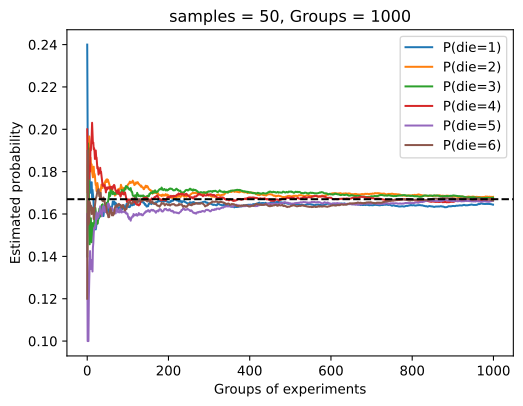
#hide_input
counts = tfp.distributions.Multinomial(100, fair_probs).sample(100)
cum_counts = tf.cumsum(counts, axis=0)
estimates = cum_counts / tf.reduce_sum(cum_counts, axis=1, keepdims=True)
plot_estimates(estimates, f"samples = 100, Groups = 100")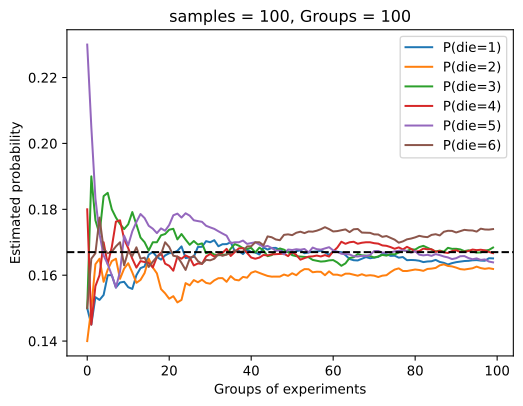
#hide_input
counts = tfp.distributions.Multinomial(10, fair_probs).sample(10000)
cum_counts = tf.cumsum(counts, axis=0)
estimates = cum_counts / tf.reduce_sum(cum_counts, axis=1, keepdims=True)
plot_estimates(estimates, f"samples = {10}, Groups = {10000}")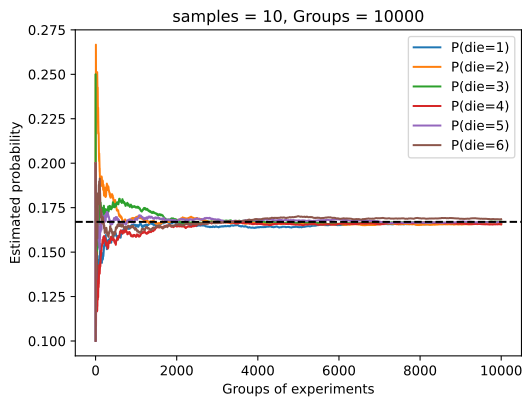
From this we can see that the more number of samples/experiment groups that we perform, the probability that a number will fall on the die getting close to 1/6.
Let’s sample 1000 from two events with \(P(A) =0.5\) and \(P(B) =0.7\) then represent the results in a venn diagram as hinted.
counts = tfp.distributions.Binomial(1, probs=[.5, .7]).sample(1000)
event_samples = list(counts.numpy().astype(int).tolist())event_10 = event_samples.count([1,0])
event_01 = event_samples.count([0,1])
event_11 = event_samples.count([1,1])venn2((event_10, event_01, event_11), ('Event 1', 'event 2'))
d2l.plt.show()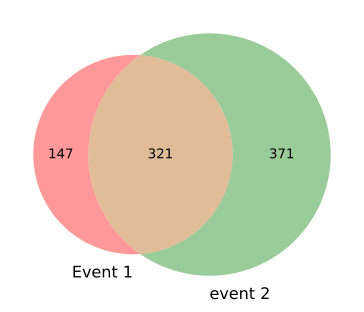
From the diagram we can see that \[ P(A) = 468/1000 = 0.468 (\approx 0.5) \\ P(B) = 692/1000 = 0.692 (\approx 0.7)\]
Assuming Upper bound for \(P(A∪B) = 1\), so that \[P(A∩B) >= P(A) + P(B) - 1 \\P(A∩B) >= 0.16\] so the lower bound of \(P(A∩B)\) is 0.16.
The upper bound of \(P(A∩B)\) would be \(min(P(A), P(B))\), since the \(P(A∩B)\) is event of both A and B ocurring together. Consequently lower bound of \(P(A∪B)\) would be \(max(P(A), P(B))\)
so, \[P(A∩B) <= 0.468\] and \[P(A∪B) >= 0.692\]
At last \[0.692 <= P(A∪B) <= 1\] and \[0.16<=P(A∩B)<=0.468\]
##Assume that we have a sequence of random variables, say A , B , and C , where B only depends on A , and C only depends on B , can you simplify the joint probability P(A,B,C) ?
Since this is a sequential occurence, A occurred first, B occurred second and at last C occurred. Let’s assume \(A, B\) as one event \(Z\)
\[P(Z, C) = P(C|Z) * P(Z) \]
substituting value for \(Z\) \[P(A, B, C) = P(C|A, B) * P(A, B) \] \[P(A, B, C) = P(C|A, B) * P(A|B) * P(B) \]
We did not conduct the same test because simply put running the same test on the same person, will not give a different result.